Solving Low Response Rates with AI Personalization

Low response rates are draining your resources. Sales teams spend 21% of their day on cold emails, yet only 5.1% get a reply. Worse, 82% of emails are never opened, and nearly 18% of legitimate ones land in spam. The culprit? Generic messages, outdated data, and poor follow-up strategies.
AI personalization fixes this by crafting tailored emails that resonate with recipients. With tools analyzing LinkedIn profiles, company news, and behavior patterns, AI can optimize subject lines, email content, and send times. Results include up to 90% open rates and 35% response rates in experiments - far beyond the industry average.
Key Takeaways:
- Subject Lines: AI creates relevant, attention-grabbing subject lines, boosting open rates by 50%.
- Email Content: Tailored messaging addresses specific challenges, increasing response rates by 32.7%.
- Timing: AI predicts the best times to send emails, improving engagement by 23%.
- Behavioral Triggers: AI tracks buying signals like funding news or hiring trends to send timely, relevant messages.
Platforms like Mailforge simplify scaling these strategies, automating technical tasks like domain setup, ensuring high deliverability, and protecting sender reputation. Paired with tools like Salesforge and Warmforge, businesses can send thousands of personalized emails without sacrificing quality.
If your cold outreach is falling flat, AI personalization is the solution to turn low response rates into high-impact results.
How AI Personalization Increases Response Rates
AI personalization addresses the challenges of low response rates by replacing generic outreach with tailored messaging. It focuses on four key areas: subject lines, email content, send timing, and behavioral triggers. Instead of relying on basic variable insertion, AI dives deep into data sources like LinkedIn, company news, and social media to craft messaging that resonates with each recipient.
The results speak for themselves. AI-personalized cold emails have achieved 90% open rates and 35% response rates in specific experiments. In fact, personalized emails are shown to generate transaction rates that are six times higher than generic outreach.
Creating Better Subject Lines with AI
Subject lines play a massive role in whether your email gets opened. Nearly 47% of recipients decide to open an email based on the subject line alone, while 69% may mark it as spam if it contains vague or overused phrases like "Quick question". AI can craft subject lines that reference timely, relevant events - like funding rounds, hiring trends, or social media updates. For instance, instead of a bland "Following up", an AI-driven subject line might read: "Thoughts on [Company Name]'s recent Series B expansion?".
These personalized subject lines can boost open rates by 50%, and AI-optimized subject lines have been shown to increase opens by up to 20%. AI also tests multiple variations simultaneously, identifying the keywords and tone that resonate most with specific industries while ensuring the subject line aligns seamlessly with the email content.
Writing Custom Email Content for Each Recipient
AI, powered by Natural Language Processing (NLP), analyzes unstructured data – like LinkedIn profiles, company websites, and news articles – to uncover a prospect’s pain points and business challenges. It then creates email content that directly addresses these issues. Similar AI technology powers tools like Rezi.ai, which tailor resumes to specific job descriptions, demonstrating how personalization extends beyond email. For example, if a prospect visits your pricing page, AI can dynamically adjust follow‑up messaging to emphasize ROI or implementation details. This level of personalization can result in a 32.7% increase in response rates.
Ng Zixuan, a sales specialist, sums it up well:
"AI isn't just a tool - it's an unfair advantage. I stopped using AI to write emails and started using it to understand people".
Finding the Best Time to Send Emails
The timing of your email matters just as much as the content. While conventional wisdom might suggest sending emails on "Tuesday at 10 AM", AI takes it a step further by analyzing each recipient's unique digital habits. It looks at factors like past email opens, click-through histories, and active times on various devices. Using this data, AI creates "heat maps" that predict the best times to engage each recipient, continuously updating as behaviors change.
Real-world examples highlight the impact of this approach. OneRoof, a property platform in New Zealand, saw a 218% increase in clicks and a 23% boost in click-to-open rates by optimizing send times with AI. Similarly, foodora in Austria experienced a 9% rise in click-through rates and a 26% reduction in unsubscribe rates during new customer onboarding. By syncing email delivery with behavioral patterns, your outreach becomes more precise and effective.
Using Behavioral Triggers to Stay Relevant
AI leverages behavioral triggers to ensure your outreach is timely and relevant. By tracking buying signals - such as funding announcements, hiring trends, or job changes - AI can initiate contact within a 24–48 hour window. For instance, if a company announces a new VP of Sales, AI can automatically send an email referencing the hire and explaining how your solution supports sales team expansion. Similarly, if a prospect downloads a whitepaper, the follow-up email can be tailored to discuss insights from that specific content.
This approach transforms cold outreach into meaningful, timely conversations, ensuring your message lands when the recipient is most likely to engage. These adaptive strategies set the stage for scalable campaign success, which will be explored further in the next section.
<script>(function(d,u,ac){var s=d.createElement('script');s.type='text/javascript';s.src='https://a.omappapi.com/app/js/api.min.js';s.async=true;s.dataset.user=u;s.dataset.campaign=ac;d.getElementsByTagName('head')[0].appendChild(s);})(document,372145,'bgla6zdvtvvykvmfmifs');</script>
Scaling AI Personalization with Mailforge
While AI handles the finesse of crafting personalized email content, getting those emails delivered reliably is a whole different challenge. When you're sending hundreds or even thousands of tailored emails every day, the real hurdle becomes your infrastructure. Setting up domains and mailboxes manually? That's a time sink - and an expensive one. Mailforge steps in to automate this process, slashing costs and ensuring your AI-powered email strategies can operate at full capacity.
Setting Up Campaigns Faster with Mailforge
Mailforge makes campaign setup a breeze. Instead of spending hours configuring SPF, DKIM, and DMARC records for every domain, Mailforge automates the entire DNS setup process in just 2–3 minutes - for all domains. Need hundreds or even thousands of domains and mailboxes? No problem. The platform handles bulk DNS updates, SSL certificates, and domain masking, so you can focus on crafting your AI-personalized emails instead of wrestling with technical configurations. Once the setup is complete, the next step is preserving your sender reputation.
Maintaining High Deliverability at Scale
Sending high volumes of emails can be tricky - push too hard, and your deliverability takes a hit. Mailforge tackles this with features like SSL and domain masking, available at accessible rates (starting at $2/month or $6/year). These tools help spread email volume across multiple domains and mailboxes, protecting your sender reputation. Pair this with Warmforge, which offers unlimited email warm-up, and your mailboxes can gradually build trust with email providers. Tools like Salesforge's mailbox reputation scores and inbox placement testing let you monitor performance in real time, ensuring your AI-personalized emails don't end up in spam. And when integrated with other tools, your outreach becomes even more impactful.
Connecting Mailforge with Other Forge Tools
Mailforge doesn’t just work alone - it’s part of a larger ecosystem. It integrates seamlessly with the full Forge stack, giving you a powerful toolkit for scaling personalization. Salesforge ($40/month for the Pro plan, billed annually) manages AI-driven sequences across email and LinkedIn, applying tailored touches to every message. Warmforge keeps your mailboxes warm and your sender reputation intact. Then there’s Agent Frank ($499/month, billed annually), an autonomous AI SDR that takes care of lead generation, follow-ups, and even booking meetings for up to 1,000 active contacts. Combining these tools in a multi-channel strategy can boost conversion rates by up to seven times compared to single-channel outreach. With native integrations across the stack, scaling AI personalization becomes effortless.
Tracking and Improving AI-Personalized Campaigns
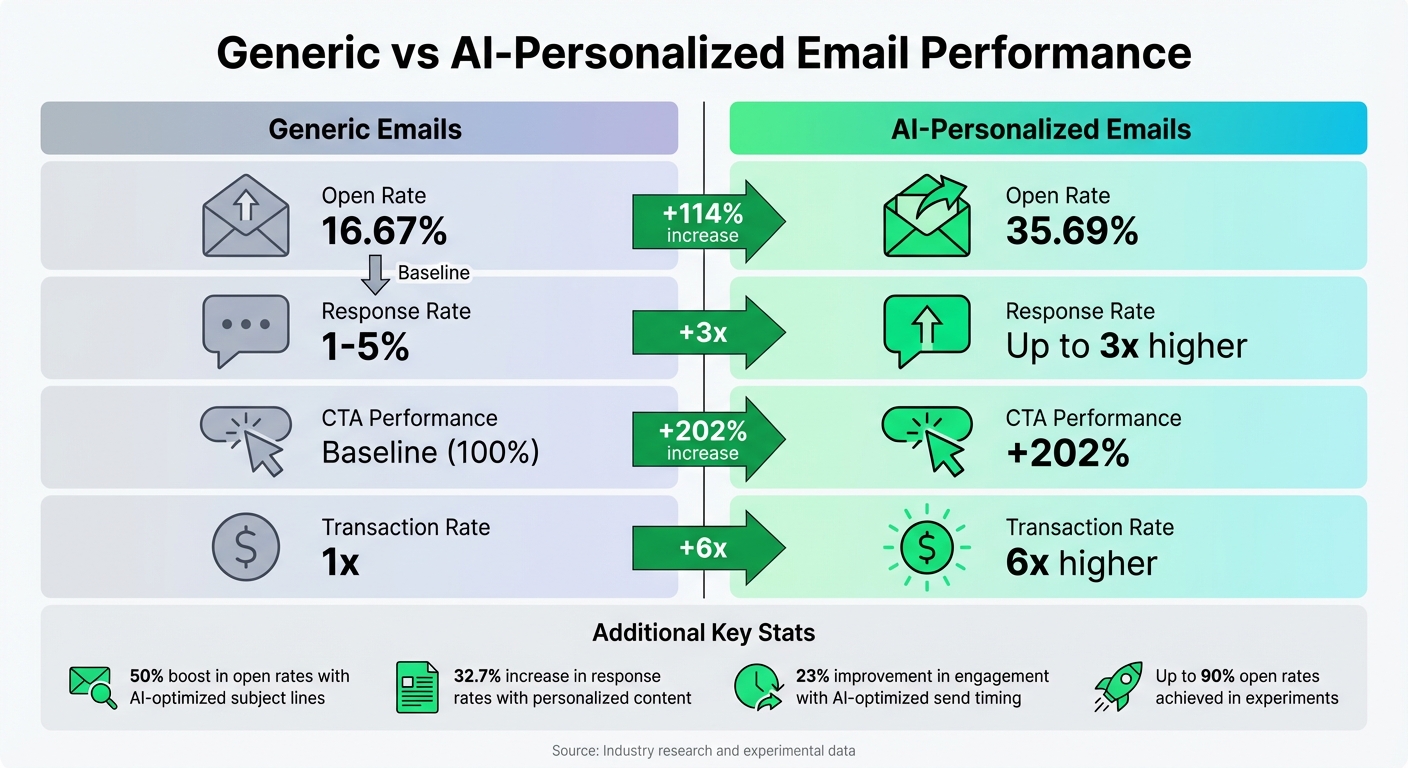
AI-Personalized vs Generic Cold Email Performance Comparison
Keeping tabs on your AI-personalized campaigns is key to tackling low response rates and fine-tuning your strategy. The results speak for themselves - 6x higher transaction rates and 50% better open rates - but staying ahead means focusing on the right metrics and leveraging the data to sharpen your approach. These metrics are the foundation for improving your AI models and delivering more tailored experiences over time.
Metrics That Matter for AI Personalization
To gauge the success of your AI-powered personalization, monitor metrics like open rates, click-through rates, response rates, Sales Qualified Leads (SQLs), meetings booked, and transaction rates. For a deeper understanding of engagement, the Reply Quality Score - which assesses responses as positive or negative - offers more clarity than just counting replies. Additionally, keep an eye on bounce rates, unsubscribe rates, and mailbox reputation scores to ensure your emails are landing in inboxes, not spam folders. Companies using AI for lead scoring have seen a 20% boost in sales team productivity, but only when they're tracking the right signals.
Testing Personalized vs. Generic Emails
A/B testing is a straightforward way to prove the value of AI personalization. By comparing a control group receiving generic templates to a test group getting AI-personalized content, the results often speak for themselves. For example, AI-personalized subject lines achieve 35.69% open rates, compared to just 16.67% for generic ones. Similarly, personalized calls-to-action outperform generic ones by 202%. Here’s how the numbers stack up:
| Metric | Generic Emails | AI-Personalized Emails |
|---|---|---|
| Open Rate | ~16.67% | ~35.69% |
| Response Rate | ~1-5% | Up to 3x higher |
| CTA Performance | Baseline | +202% |
The key to effective personalization lies in focusing on high-value data points. Instead of just using surface-level details like first names, tailor content to role-specific challenges or triggers such as recent funding rounds or new hires. Insights from these tests can then be used to refine your AI strategies further.
Using Campaign Data to Improve AI Models
The true strength of AI personalization lies in its ability to learn from the data you provide. Track all interaction outcomes, including objections, timing preferences, and decision-making cues, to teach the AI which personalization tactics work best. For instance, a CEO downloading an ROI calculator is a high-intent signal that carries more weight than a standard homepage visit. AI-optimized subject lines, when continuously tested and refined, can boost open rates by up to 20%.
As Florin Tatulea, Head of Sales Development at Common Room, puts it:
"Intent data is powerful but only useful if you reach out immediately. In most cases, it's not useful if you reach out 2 weeks later".
To make the most of this data, build feedback loops that capture timing insights and use them to improve how and when your AI personalizes future outreach. By continuously feeding performance data back into your system, you can refine every stage of the outreach process, enhancing your campaigns' overall impact and scalability.
Conclusion
What AI Personalization Can Do for Your Campaigns
AI personalization addresses a major issue plaguing cold email campaigns: generic messaging that prospects simply ignore. By using AI to tailor your outreach, you can see a 50% increase in open rates, a sixfold jump in transaction rates, and significant improvements in both SQL generation and sales team efficiency. This isn’t just about adding a recipient’s first name - it’s about creating emails that truly resonate with their unique challenges.
The numbers speak for themselves. While traditional cold email campaigns often struggle to achieve a 5.1% response rate, AI-driven approaches can push open rates to as high as 90% and response rates to 35% in experimental settings. Personalized calls-to-action perform 202% better than generic ones, and even optimizing send times with predictive AI can increase open rates by 23%. As Alex Hormozi, author of $100M Leads, explains:
"If you can set up the tech to accomplish both - personalization and volume - you create a deadly effective lead-getting combo".
These impressive results highlight the importance of having a strong technical foundation to support your AI-powered campaigns.
Get Started with Mailforge
To unlock the full potential of AI personalization, consider using Mailforge, an automated platform designed to handle the technical complexities of large-scale email campaigns. Mailforge simplifies tasks like DNS setup, SSL and domain masking, and bulk mailbox configuration - allowing you to scale up your campaigns in just minutes. Starting at $25/month for 10 mailbox slots (billed annually), Mailforge integrates seamlessly with the Forge Stack, which includes:
- Salesforge: AI-powered email sending.
- Warmforge: Tools to maintain sender reputation.
- Leadsforge: Verified lead list generation.
- Agent Frank: Fully autonomous AI SDR management for $499/month.
Infrastructure is key because even the best-crafted email won’t deliver results if it ends up in spam. With high-performing campaigns requiring at least 85% deliverability, it’s worth noting that 17.7% of legitimate marketing emails fail to reach inboxes without the right setup. By combining AI personalization with Mailforge’s scalable infrastructure, you can turn low response rates into high-impact outreach - boosting engagement and converting leads into customers.
FAQs
How can AI-powered personalization boost email open and response rates?
AI-driven personalization takes email performance to the next level by creating messages tailored to each recipient using real-time data. This method doesn't just make emails more relevant - it makes them more engaging. In fact, it can lift open rates by as much as 50% and improve reply rates by 2 to 6 times.
By delivering emails that feel genuine and specifically targeted, this approach helps your messages cut through the noise of crowded inboxes, ultimately driving stronger results for your campaigns.
How does timing impact the success of AI-driven cold email campaigns?
Timing is a game-changer for the success of AI-driven cold email campaigns. It’s all about choosing the right moment - when your prospects are most likely to notice and engage with your message. AI tools can analyze patterns in recipient behavior, like when they usually check their inbox, and schedule emails to land during those peak times.
Research highlights that mid-week emails, particularly on Tuesdays, tend to have higher open rates. AI takes this a step further by syncing email delivery with a recipient's most active work hours. Pairing this precision with personalized content can significantly improve both open and reply rates, transforming cold outreach into productive conversations. Tools like Mailforge make it easier to apply these strategies on a large scale, ensuring your emails not only reach the right audience but also maintain strong deliverability.
How does Mailforge help scale personalized cold email campaigns effectively?
Mailforge takes the headache out of managing large-scale cold email campaigns by offering a shared email infrastructure that supports hundreds or even thousands of domains and mailboxes. It handles time-consuming tasks like DNS setup (SPF, DKIM, and DMARC) automatically, ensuring your emails are properly authenticated to stay out of spam folders. With features like domain masking and SSL, you can quickly set up new sending domains, making it easy to segment your audience by industry, region, or product line - all while safeguarding your sender reputation.
When paired with AI tools such as Salesforge for dynamic personalization and Agent Frank for autonomous outreach, Mailforge enables you to send customized emails at scale. AI can craft hundreds of tailored emails daily, while Mailforge ensures smooth delivery by managing tasks like IP rotation and mailbox setup. This combination leads to significantly higher open and reply rates compared to generic mass emails.
For a complete cold email solution, Mailforge works seamlessly with other Forge tools like Leadsforge for lead generation, Warmforge for IP warming, and Primeforge for managing Google Workspace or Microsoft 365 mailboxes. Together, these tools simplify the entire process - from finding leads to personalizing and sending emails - turning low-performing campaigns into engaging conversations that deliver measurable results.